top of page


Search
Publication


Light-controlled materials open new possibilities - new research published in Advanced Optical Materials
A new “smart” optical material that can be tuned simply with light has been developed, opening new possibilities for future photonic technologies. The work focuses on polarization volume gratings (PVGs), special chiral liquid crystal structures, that don’t just reflect light, but diffract it very efficiently, making them promising for applications like augmented reality displays. To control these materials, the team introduced hydrazone photoswitches, molecules that can rever
May 6
Please check new research article of SPM about light-controlled “living” surfaces in Nature Communications
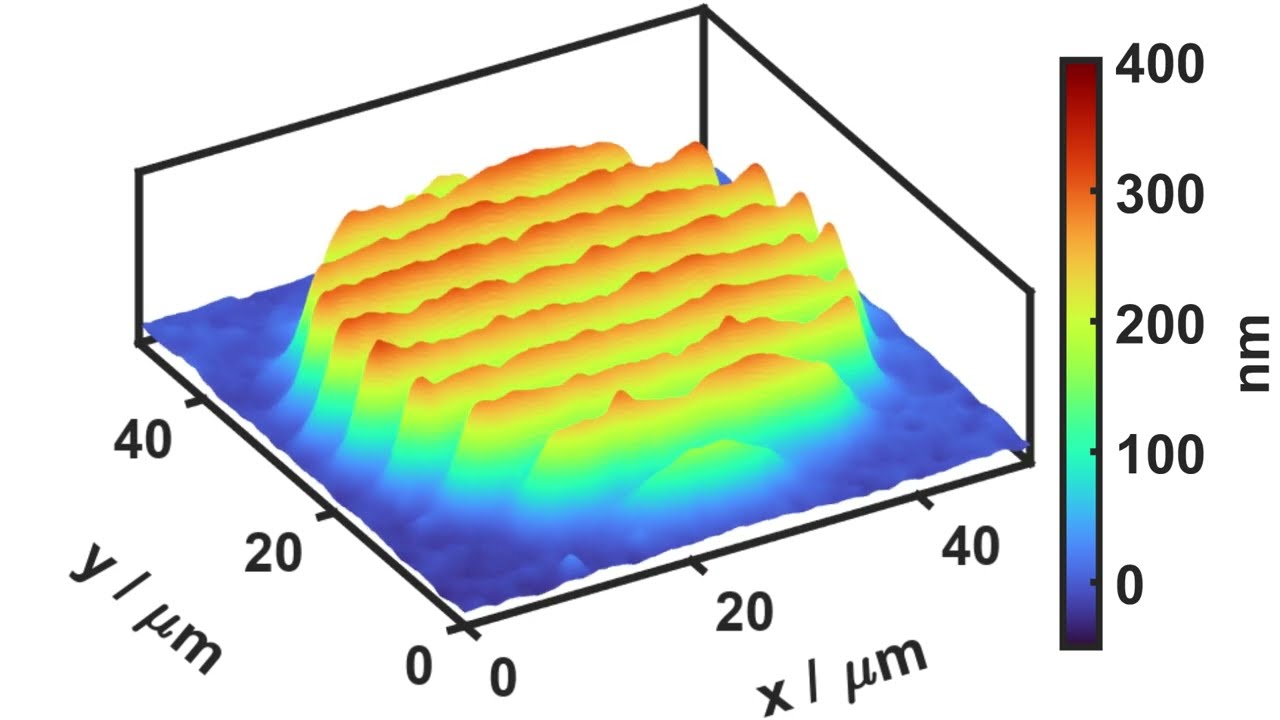
Researchers at Tampere University have developed a novel soft material that can change shape when exposed to light, without any physical contact. Using precisely controlled light, the material forms tiny, dynamic surface patterns that can even move small objects across it. This work marks an important step toward creating “living‑like” materials that can adapt and respond to their surroundings, with potential applications in sensing, photonics, and biomedical technologies. Yo
Apr 24


New article about advance photonic control of programmable pixelated lasers is out
A new study in Advanced Optical Materials shows a way to build lasers that can be “programmed” to produce different colors in different tiny areas (pixels). Sudharsana Bhashyam Pillailokam and Alex Berdin created a material surface where each small spot can emit its own laser color, and many of these spots can work together at once. This is done by carefully shaping microscopic patterns using advanced light-based techniques. This makes it possible to design custom light sourc
Apr 10


New paper about laser-induced undulatory locomotion in liquid crystalline elastomers.
The study shows how liquid crystalline elastomer (LCE) can bend and crawl using controlled laser heating. The researchers took inspiration from C. elegans , a small worm that moves by bending along its body. By shining a laser on different parts of the fiber in sequence, the scientists made LCE strip bend in a similar pattern. This wave motion allows the fiber to move forward without any motors or electronics inside it. The system is simple: light heats small areas of the mat
Mar 3


New Light-Driven Twist on Water-Soluble Polymers Breaks Efficiency Records
In a new Angewandte Chemie paper, researchers report a major advance in controlling water-soluble azopolymers with low-energy visible light by using a strategy called sensitized disequilibration (DESC) . Traditionally these molecular switches require harmful UV light, but by combining DESC with polymers made via RAFT, the team achieved switching efficiencies up to about 85 % under yellow light , opening doors for light-driven soft materials and biomedical applications. A sp
Jan 5


New Laser-Sensor Breakthrough Harnesses Hydrogel Microcavity
Shuai Zang and Matias Paatelainen have developed a hydrogel-based hybrid microcavity laser sensor that uses the unique interaction between soft hydrogel materials and plasmonic effects to dramatically boost laser-based sensing performance. This novel sensor, published recently in ACS Sensors , exploits the microcavity’s optical resonance to achieve enhanced detection sensitivity, potentially opening new avenues for ultrasensitive chemical and biological sensing technologies.
Dec 29, 2025


Light‑Driven “Smart” Material Oscillates When Loaded
Zixuan Deng together with other researchers from Tampere University and Anhui Jianzhu University (China) have developed a novel light‑fueled self‑oscillating material that responds to mechanical force, opening paths toward adaptive soft robots and sensors. The team used a light‑responsive liquid‑crystal network (LCN) strip that, under constant illumination and an applied load, transitions from static deformation to continuous motion. The oscillation amplitude increases with
Sep 25, 2025


Polymer Coatings Make Light-Responsive Films Stable in Water
Mari Isomäki and colleagues from Tampere University have found that thin polymer coatings can protect light-responsive azobenzene films in water, making them suitable for biomedical applications. The films, which change surface patterns when illuminated, usually degrade or blister in aqueous environments. Coatings of PDMS and parylene C preserved their functionality, with parylene C performing best , preventing damage and enhancing cell compatibility. These results suggest po
Aug 15, 2025


New Editorial in Chemical Science Highlights Commercialization of Supramolecular Chemistry
A new Chemical Science editorial showcases how supramolecular chemistry is progressing toward commercialization , with contributions from Anthony P. Davis, Jennifer R. Hiscock, Calden N. Carroll, Michael M. Haley, Darren W. Johnson, Jonathan F. Arambula, Krystle Karoscik, Jonathan L. Sessler, and Arri Priimägi and Matti Virkki representing Tampere University. The article, “Making molecules work – stories of supramolecular translation” , presents real-world examples of mole
Aug 7, 2025
Chemists Reveal Color-Shifting Molecule That Senses Temperature
Antti and Sami discovered that a light-responsive molecule called azobenzene changes color depending on temperature when it interacts with acid. Their experiments and computer models showed that colder conditions shift the balance between protonated and non-protonated forms, opening up possibilities for simple temperature sensors . This collaboration highlights how lab work combined with theory can turn basic chemistry into practical tools. Read more ...
Jul 25, 2025


New article about halogen-bonded elastomers for light-powered soft robotics is out!
A new study in Advanced Materials presents halogen-bonded liquid crystal elastomers that act as initiator-free photochemical actuators , enabling precise light-driven movements. These materials show multimodal actuation , including rolling and underwater gripping, offering exciting potential for soft robotics and adaptive devices. The work is a collaboration including Tampere University, Aalto University and University of Cambridge . Congratulations to Hongshuang Guo and t
Jun 17, 2025


Shape‑Shifting Materials Powered by Chalcogen Bonds
Hongshuang Guo and collaborators from Tampere and Jyväskylä universities have developed liquid crystal elastomers (LCEs) that combine shape memory and actuation using chalcogen bonds (Se⋯N and S⋯N interactions) . Published in Angewandte Chemie ( DOI: 10.1002/ange.202508101 ), the study shows that Se‑based LCEs enable reversible shape changes, rewritable surface patterns, and even light‑driven micro‑robots, while S‑based LCEs lack these dynamic behaviors. Advanced spectr
Jun 5, 2025


New Welding Strategy Enables Complex-Shaped Liquid Crystal Elastomer Actuators
Researchers at Tampere University have developed a novel welding‑based fabrication method for liquid crystal elastomer (LCE) actuators, allowing the assembly of complex, multicomponent soft robotic structures with programmable shape transformations. Jie Jiang and the team demonstrated that dynamic disulfide bonds can weld LCE segments while preserving molecular orientation, overcoming limitations of physical adhesives and enabling sophisticated actuator designs. This work was
May 26, 2025


Our new collaborative paper about halogen bonding in organic semiconductors is out!
A new scientific publication has shown that halogen bonding can be a powerful tool for boosting the performance of organic electronic devices , a breakthrough recognized by its selection as the cover article of the journal issue . By applying strong, directional halogen bonding to a pyridine-substituted naphthalene diimide (NDI) semiconductor, the study demonstrates how molecular packing and solid-state morphology can be precisely controlled—key factors governing charge trans
May 6, 2025


Check out a new paper about liquid crystal elastomer rings showing collective motion without electronics
Concept of the study
Apr 30, 2025


Our fresh paper about magneto-photochemical underwater actuation of liquid crystal elastomer is out!
Yasaman Nemati published her second PhD thesis paper about materials combining both magnetic and optical responsiveness offering powerful, dual-mode control in underwater actuation. Great achievement! Collaborative work of the SPM group with groups of Prof. Hao Zeng (Tampere University) and Prof Jaakko Tiimonen (Aalto University, Finland), as well as Prof. Carlos Sánchez-Somolinos (CSIC-University of Zaragoza, Spain), demonstrates that dual-responsive LCEs that combine magnet
Jan 13, 2025


Check out a new paper about hydrogen-bonded liquid crystal elastomers with shape memory effect!
The first paper for Roshan Nasare's PhD work featuring a supramolecular liquid crystal elastomer actuator with integrated shape memory function is out! Congratulations! In the work, the authors Roshan Nasare, Hongshuang Guo and Arri Priimägi present a multi-mode, supramolecular liquid crystal elastomer actuator that integrates shape memory programming, humidity sensitivity, and photochemical actuation, depending on the pre-activation conditions. Switching between different st
Jan 2, 2025


New paper about Stokes regime swimming of liquid crystal elastomer torus
SPM congratulates Zixuan Deng with the publication of his PhD research in Nature Materials journal! In the paper, Deng et al. report a...
Nov 1, 2024


Our new paper about azobenzene isomerisation in polymer thin films for hymidity sensing is out!
6 SPM people at once authored the paper and the biggest contributions are made by Sami Vesamäki and SPM alumnus Matti Virkki! The paper...
Oct 3, 2024


Our fresh review paper about photoswitching via indirect excitation in Chemical Science is out!
Sometimes a detour is the way to find a new exciting research direction and publish a review on it in Chemical Science. Kim Kuntze from...
Jul 9, 2024
bottom of page